
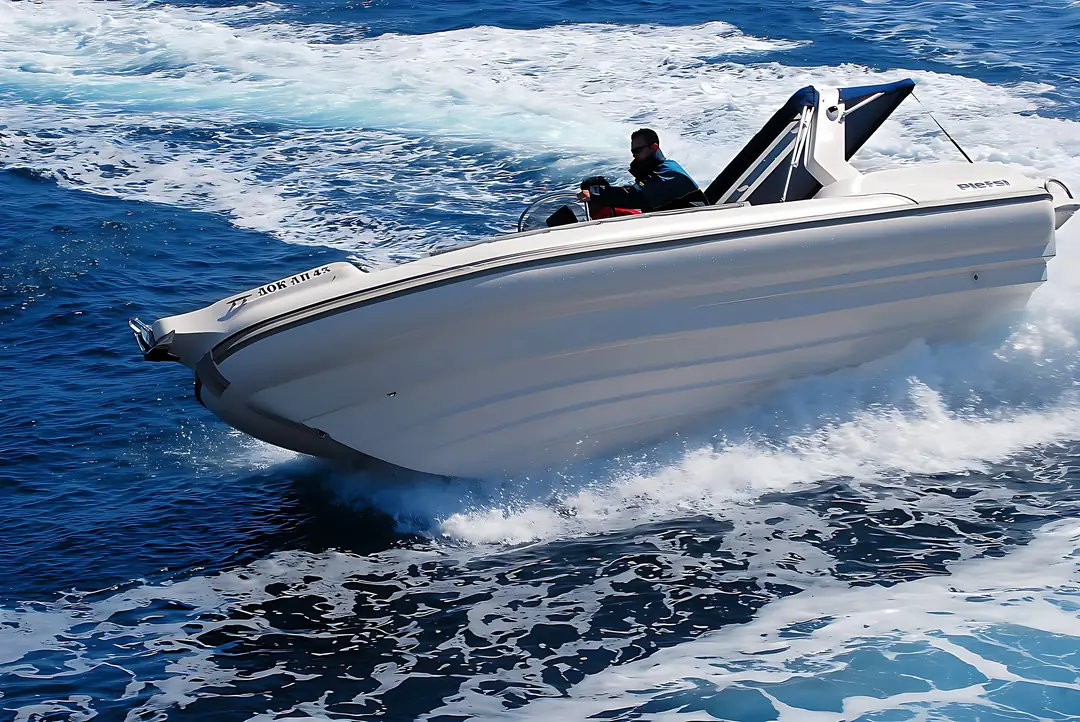
The main difference is the material of the buoyancy tube. PVC is lighter and usually cheaper, but it is less resistant to the sun, heat, and fuel. Hypalon is heavier and more expensive. However, it lasts longer if the boat stays out all summer and is easier to repair with glue.
Below you will see how to tell the two materials apart, what each means for repair, and which suits your specific use.
What PVC and Hypalon Are
Both feature a base fabric with a coating. What changes is the coating and the way the pieces are joined together.
PVC
PVC is plastic (polyvinyl chloride) applied to a synthetic fabric. Its seams are joined with glue or heat-welding. In heat-welding, the two pieces are melted with heat and become one. This is done with machinery, which is why many inflatable boats on the market are made of PVC, especially smaller ones and tenders.
Hypalon
Hypalon refers to the synthetic rubber (CSM) that covers the outer side of the fabric. On the inner side, there is usually neoprene, which holds the air. Seams are joined exclusively with glue and by hand. The company that gave the name stopped producing it years ago. However, equivalent CSM fabrics are still made by other manufacturers, and the market continues to call them Hypalon.
The Differences in Practice
Sun and Heat
For anyone who keeps a boat in Greece, this is the biggest difference. Hypalon resists ultraviolet radiation and high temperatures much better. Over time, PVC can fade, harden, or become sticky to the touch, and its seams may start to open. This happens faster when the boat is left uncovered in a marina or on a trailer.
Fuel, Oil, and Abrasion
Gasoline, oil, and solvents affect PVC more. Hypalon resists them better. It also resists abrasion from rocks, piers, or sand better.
Weight
PVC is lighter. This matters if you lift the inflatable by hand, put it in your car, or if a larger boat carries it as a tender. For the same size, Hypalon turns out heavier.
Purchase Cost
A Hypalon inflatable usually costs more than its PVC counterpart. The fabric is more expensive, and manufacturing requires more hours of manual labor. The difference varies from manufacturer to manufacturer, so compare specific models.
Lifespan
With the same care, a Hypalon tube usually lasts more years. But a PVC boat also holds up well if you rinse it with fresh water, cover it, and store it in the shade. Storage matters just as much as the material.
What Changes in Repair
We see this every day in the workshop. Each material requires its own patching fabric and its own glue. PVC glue does not hold properly on Hypalon, and the same applies vice versa. Therefore, before any repair, you must know what material you have.
- Hypalon: bonds well with two-part glue. Patches, reinforcements, and accessory bonds hold even on an old tube, as long as the surrounding fabric is sturdy.
- PVC: can be repaired as well. However, when the material has aged from the sun, the glue bonds with more difficulty. On heat-welded boats, an opened seam is re-glued using adhesive and reinforcement.
When the tube is worn in many areas, patches are not enough and a new tube is needed. In this case, you also choose the material. An example is the replacement of a Hypalon tube on a Bat inflatable. You will find more before and after photos in the inflatable boat repairs we have completed.
How to Tell What Material Your Boat Has
- Check the builder's plate or boat papers. The manufacturer usually writes the tube material there.
- Look at the seams. If the joints are thin and uniform and show no traces of glue, it is usually heat-welded, meaning PVC. Glued seams can be found on both materials.
- Look at the surface. Hypalon is usually matte, while PVC often has more gloss.
- Ask someone who knows. If you are not sure, a technician can tell the difference at a glance. It is best to find out before buying glue.
Which One to Choose
Neither material suits everyone. Start with how you use the boat.
PVC suits you if
- the boat is small or a tender and you lift it frequently
- you take it out a few times a year and store it covered or in storage
- you want a lower purchase cost
Hypalon suits you if
- the boat stays in the sea or a marina all summer
- you use it heavily or professionally, for example in marine activities
- you want to keep it for many years and repair it instead of replacing it
If you are buying used, do not look only at the material. An old Hypalon tube left in the sun may be in worse condition than a PVC one that was cared for. Check the seams and valves, and see if it holds air for a day.
If you want an opinion on your own boat, bring it to the workshop in Ilioupoli or contact us at 210 996 3152. We have been repairing PVC and Hypalon inflatables since 1990.
Frequently Asked Questions
Can I patch Hypalon with PVC glue?
No. Each material requires its own glue and its own patching fabric. Otherwise, the patch will not hold.
Can I put a Hypalon tube in place of a PVC one?
Yes. When a new tube is made, you choose the material. Whether it is worth it depends on the condition of the hull and the use of the boat.
Which material resists the sun better?
Hypalon. Whatever material you have, the biggest difference is made by covering it and rinsing it with fresh water after the sea.
Is Hypalon still available on the market?
The original brand is no longer produced. CSM fabrics with the same properties are made by other manufacturers and are used in inflatables and repairs.
Is a PVC inflatable a bad choice?
No. If you use it lightly and store it properly, it is a sensible choice with a lower cost. However, it requires more care regarding the sun.